Monday, November 15, 2010

Just when I thought the itching was over......


Today, I had a 7 month old German Shepherd come in because she was loosing hair over her face. She was doing so much scratching she would keep her owners up at night.

When I walked into the room, our happy Gemma, looked rather pathetic. Her entire face was bald with scaly flakes of irritated skin. We proceeded to do skin cytology and skin scrapings. The diagnosis literally waved its legs at us through the microscope. Demodectic mange (aka Demodicosis).

All dogs get these mites from their mothers but if the dog’s immune system becomes compromised, they can start to multiply and cause disease. Generally, this mange cannot be spread to other dogs (unless other dogs are immunocompromised). The two most common forms of Demodicosis are localized (small scaly bald patches on the face) and generalized (involves large sections of the animal and the secondary bacterial infections are itchy).

Gemma is lucky because young dogs are more likely to naturally gain control of the disease. To help her fight this disease we started her on antibiotics and Ivermectin. We were able to start the Ivermectin today as there is a very low risk she will be sensitive to it. It cannot be used in Collies, Shetland Sheepdogs, Australian Shepherds and Sheepdogs unless a specific blood test is performed to check for ivermectin sensitivity. To determine when we stop treating, we will need to get two skin scrapings two weeks apart that are negative and then one more skin scraping a month later to make sure there won’t be a relapse.

Sunday, November 7, 2010

Holy Ouch!!!


I had one of the neatest dental surgeries that I’ve had in ages. I’ve known Morris, a 10 year old DSH cat for the past few years. He has never been a “white smock” fan and since I tend to wear them…….. On his last physical exam, I noticed that he had fractured one of his upper canine teeth. The pulp was black so we needed to go forward with dental surgery.

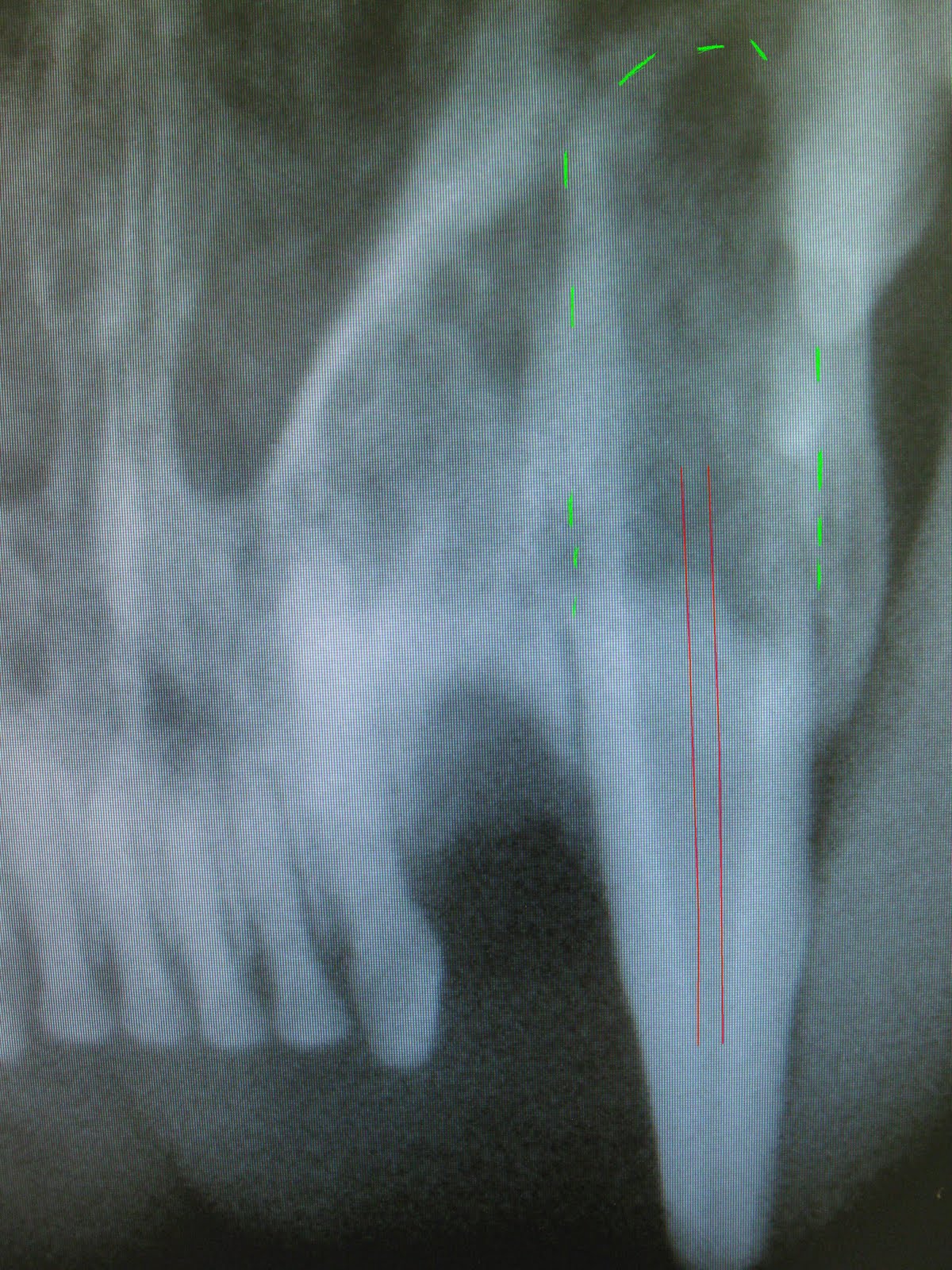
Before removing teeth, I almost always take a radiograph. I want to see what shape the roots and bones are in. I was more than a little confused when I saw the radiograph for this tooth. Normally, the pulp of a mature cat or dog becomes a very narrow. The pulp on this one got so large the root basically disappeared.

I carefully elevated and drilled around the tooth root. I tried to be even more delicate than usual removing the root. I was astounded as the tooth was completely full of abscessed material. Then I had to use a special tool to scrape the rest of the abscess out of the pocket. The gums were sutured closed and my AHT, Kelly, finished the charting, cleaning and polishing.

I know that Morris will feel much better having that abscessed tooth out of his mouth. I wish that he would associate that feeling with the white smock.

Picture: the red line represents where the pulp should be and the green lines represent where the tooth root should be.

Thursday, November 4, 2010

The Itch Factor


When I arrive at work in the morning, I will often have a quick peak at the day’s appointments. This week, I noticed one appointment with a note saying the dog was itchy. No problem. I’ve seen quite a few itchy dogs lately (food allergies, canine atopy, ear infections) so I wasn’t surprised. Well, that was going to change!!!!

I entered the room and found a dog that couldn’t stop scratching and twitching its skin. His owner mentioned that he had been quite itchy for a week and had taken him to the groomers two days ago. She had not seen any improvement after the bathing.

For kicks, I grabbed my flea comb and used it down his back before starting my physical exam. I pretty much became instantly itchy myself. Off came oodles of lice. Then I excused myself from the room and ran for the topical medication to kill them off. The sooner we got rid of them, the sooner he would be comfortable.

Now why am I still feeling itchy?

Tuesday, October 26, 2010

Sometimes Dr. Google Isn’t Right


We are dealing with a rather unfortunate case right now. Last Tuesday, one of our one year old 55lb Heinz 57s decided that eating some Ibuprofen tablets would be a good idea. When Patches’ owners went online, the website told them that if the dog had vomited, then they shouldn’t have to worry.

Friday morning we got a call from her owners saying she was lethargic, had a poor appetite and was drinking so much she was having accidents in the house. They thought she’d had 10 to 12 of the 400mg tablets. When a dog the size of Patches eats 4000mg of Ibuprofen it causes renal (kidney) failure, GI ulcers, vomiting and abdominal pain. We sent bloodwork to the lab and sure enough, she had acute renal failure.

She had to stay in our ICU for the weekend. High doses of IV fluids, an antibiotic and three medications to help with ulcers of the stomach and intestines. Repeat bloodwork showed some improvement. By the time I sent her home, she had a wonderful case of cabin fever (I love this cause it means they are feeling much better!). We won’t know for 2 weeks whether or not this has caused long term kidney damage. I will keep you posted.

So, if your animal gets into your pain medication, please call your veterinarian immediately!!! Playing the wait and see game can potentially have a devastating outcome.

Sunday, October 24, 2010

Revenge on the Ranula


As a student, I discovered my first ranula when my Magic, a female black Lab, woke up and was salivating all over the apartment. Luckily I lived over a veterinary hospital and I was waiting downstairs for one of the vets to arrive. A ranula is a collection of saliva that has leaked from a salivary gland that has become damaged. The most common causes are chewing on foreign materials, choke collars or bite wounds. In her case, a stick was not her friend. Dr. Prowse lanced it and all was well.

Over the past couple of months, I had a patient, Britt, whose ranula kept reoccurring. The first time I lanced it with a very sharp pair of small scissors and out poured the bloody saliva. Of course, I thought it was cool but the reaction by others in the room was more along the line of “oh gross!”

The second time it became enlarged, I attempted to lance it but nothing came out. The lining of the gland was significantly thickened. I warned the owner there was a chance we would need to do a surgical procedure called marsupialization.

Sure enough, it grew again so we went to surgery. Not going to lie, it was pretty neat. Basically I cut out the balloon and sutured the lining of the ranula to itself. Britt woke up pretty happy not to have the saggy balloon hanging out of her mouth.

Wednesday, October 20, 2010

Joyous Miracles


Last week, one of my clients came in to have a radiograph done on her pregnant dog, Joy. This breeder is very responsible, she makes sure to have all of the appropriate tests done prior to breeding (OFA certification of hips, Optigen test for PRA, eye certification and Baer testing for hearing). Her dogs have their championships and has litters maybe once per year or every other year. We were very happy to see four cute little puppies.

Right before surgery this morning, I received a call saying that Joy had started whelping (having pups) at 4:30 am. Her owner found that she was having weak, inconsistent uterine contractions. The second puppy arrived just after 6:30am. Since it was now almost 9am, I told her to bring Joy right in. Surgery was going to have to wait.

While waiting for her to arrive, I prepared the staff. We needed to have the exam room set up with blankets, small towels (for drying the puppies off), suture (tying off the umbilical cord and betadine to clean the end of the cord. The surgery room was also set up in case we needed to do an emergency caesarian section.

Upon arrival, both the owner and Joy appeared very tired. The two newborns looked strong. I did an internal vaginal exam but only got a mild Ferguson’s reflex (when the uterus is palpated, it should contract). Oxytocin was given to stimulate contractions and the last two finally arrived. Sighs of relief were heard all around when the squeals started up and the best part was watching the babies starting to suckle.

Sunday, October 17, 2010


This weekend I did a presentation for the Foothills Humane Society. The topic I was given was “Canine Aggression, Fears and Phobias: Treatment and Prevention”. A slightly daunting task to talk about for only 1 ½ hours. To a captive audience I could talk forever about behaviour. To keep it interesting, I added as many pictures and videos as I could. What I hadn’t expected was the effect of talking about a certain case.

This summer I took in one of my behaviour patients. Coal was an American Cocker Spaniel who had impulse control aggression and fear aggression. I had worked with his dedicated owners for almost two years but when their son first began to crawl, it was evident he would bite their son, given the right situation.

After saying I would never do it again about 13 years ago, I took Coal into my home. We needed to see if he would respond to more training in a safe place. As I do not have 2 legged children and have been training for so long, I decided to take him in. One of my thoughts at the time was that if it worked better for Coal, I could keep him and they could visit whenever they wanted.

When he was in training mode, I could not ask for a more motivated dog. He loved to make me click him. The problems occurred at random times and twice I was bitten. It was crushing to know that we would not be able to get the control we needed. Liability wise, I could not keep him as I could not guarantee he wouldn’t be put in a situation where he felt he needed to bite. I couldn’t stop the tears the day we sent Coal to Rainbow Bridge.

Coming back to the presentation, there I stood in front of a room full of people. One of the pictures I had taken of him was up and the tears started. I wanted the group to know how hard we tried but there are some cases that no matter what we do, we will not be successful. In the future I will share more of Coal’s legacy.